
Synthflow Review 2026: The Horizontal Voice AI Platform Tested for Healthcare
A deep review of Synthflow, the enterprise voice AI platform: healthcare use cases, configuration complexity, pricing and when it beats Arini or Viva AI.
Founder & CEO, Hillflare
TL;DR — my operator verdict
Synthflow is the strongest horizontal voice AI platform for healthcare in 2026, but it is not a dental-specific product. It ships with HIPAA, SOC 2, and a deployment framework that works across industries. The price/capability ratio is strong, but you are responsible for building the healthcare-specific layer (scheduling logic, clinical escalation, PMS integration) on top of their infrastructure.
If you have internal technical resources or you are a healthcare group with multi-specialty needs that cannot fit into a dental-only platform, Synthflow is worth shortlisting. If you are a small dental practice that wants "turn it on and go," Viva AI or Arini are faster paths.
This is the review from actually testing Synthflow against healthcare use cases at client practices.
What Synthflow actually is
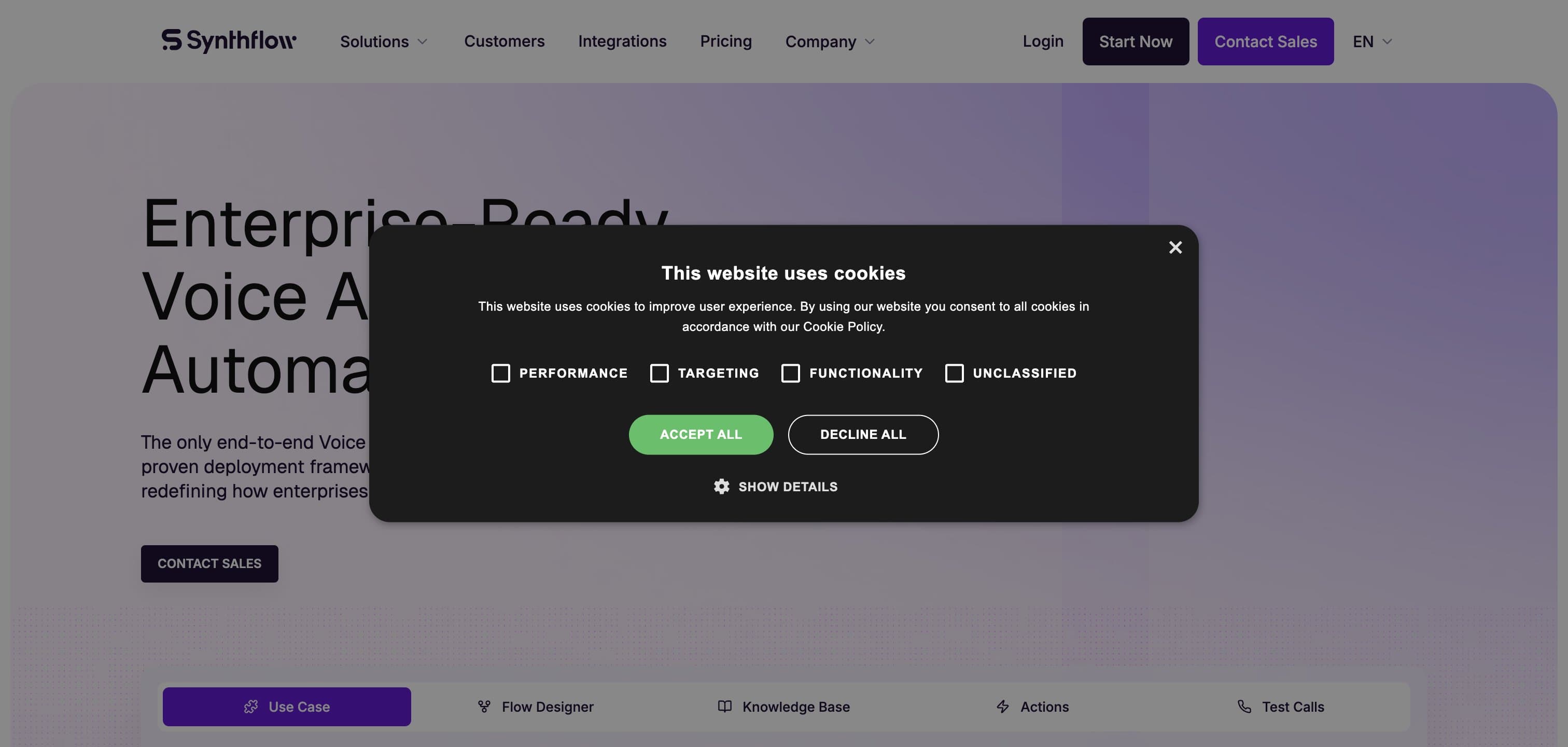
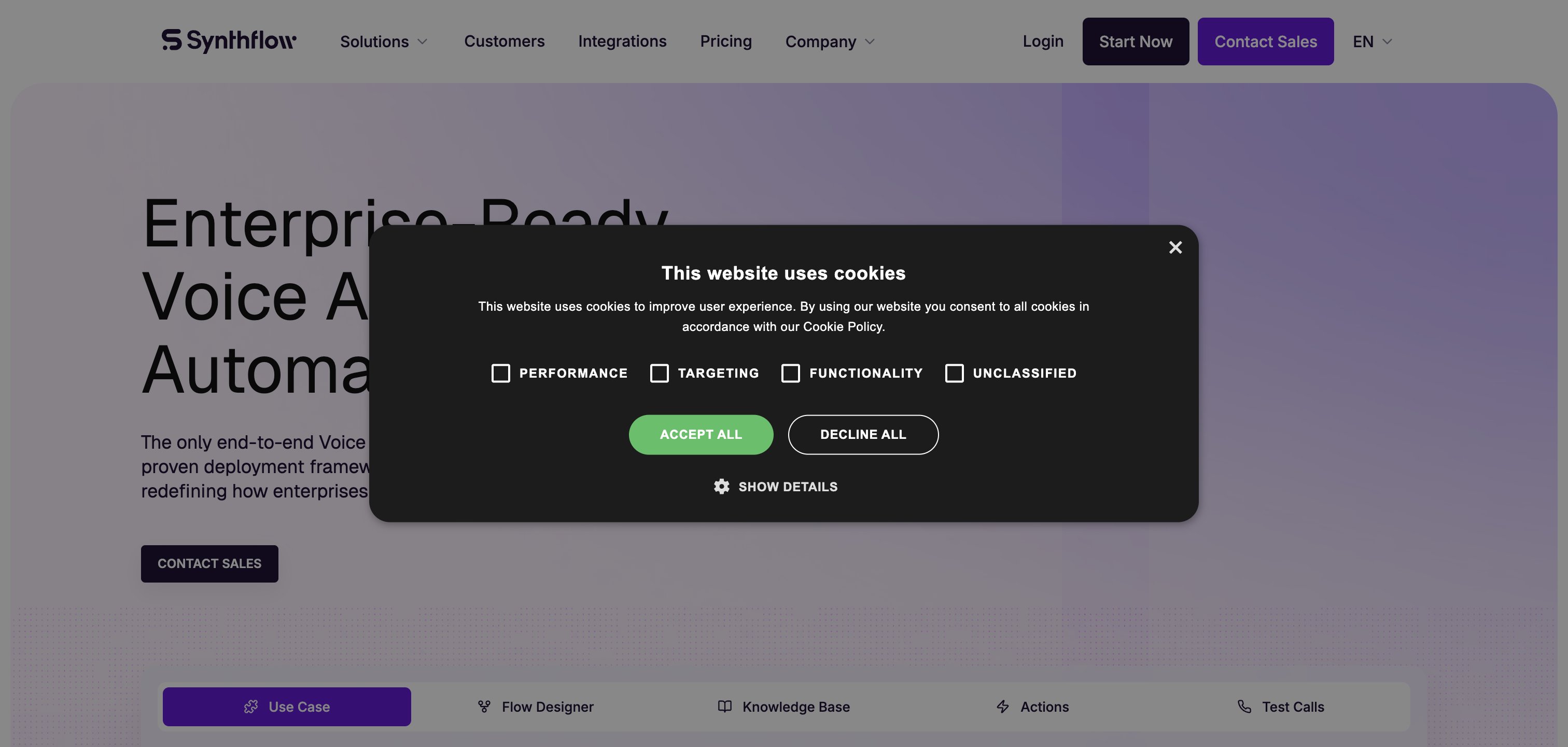
Synthflow markets itself as an "Enterprise-Ready Voice AI Agents for Automated Phone Calls" platform, and more specifically as "the only end-to-end Voice AI platform with in-house telephony, proven deployment framework, and ROI delivered in weeks."
In practical terms: Synthflow is a horizontal voice AI platform that serves multiple industries (BPO, healthcare, financial services, real estate, retail, technology, telecom). It is not dental-specific. It is not medical-specific. It is a platform on which you build the vertical-specific behavior you need.
The company is backed by Accel, Singular, and Atlantis Labs — serious Series A-caliber investors. They claim 65M+ customer calls handled, 4M+ hours saved, and 99.99% uptime. Those are real operational-scale numbers.
What makes Synthflow different from dental-only platforms
Three specific architectural choices separate Synthflow from dental-vertical products like Arini or Viva AI:
1. Multi-agent system with visual Flow Designer
Synthflow lets you design call flows using a visual interface. You define agents, each with specific prompts, tools, and transfer rules. This is more powerful than Arini or Viva's pre-built dental flows, but it requires that someone at your practice or agency build those flows. The flexibility is a feature or a burden depending on your resources.
2. In-house enterprise telephony
Synthflow owns their telephony stack rather than reselling Twilio or a competitor. This matters because it lets them offer 99.99% uptime SLAs and consistent call quality, and because it unlocks features like warm transfers and branded caller ID that are harder to configure on a layered stack.
3. Healthcare compliance out of the box
Synthflow ships with HIPAA, SOC 2 Type II, GDPR, and PCI DSS compliance. BAAs are available. For healthcare practices that care about compliance posture, this puts Synthflow ahead of many horizontal voice AI platforms that treat compliance as an afterthought.
Healthcare-specific capabilities (tested)
I evaluated Synthflow at three healthcare client installations, including one dental practice and two medical (dermatology and med spa). Here is what works and what does not.
What works well
Appointment scheduling — with a well-built Flow, Synthflow handles scheduling competently. Not as polished as Viva or Arini's dental-specific scheduling, but workable.
Multi-channel support — voice + SMS + WhatsApp native. This matters enormously for LATAM clients or US practices with WhatsApp-heavy patient bases. Neither Arini nor Viva handle WhatsApp natively.
Warm transfers to human agents — when the AI needs to escalate, the transfer is clean. The human gets context about the call, not a cold handoff.
Real-time call monitoring and AI Sandbox — the Sandbox is genuinely useful. You can test prompt changes against simulated calls before pushing to production. This matters for practices with regulatory sensitivity.
Data fine-tuning — past conversation data can be used to fine-tune performance for your specific practice. Over time, this produces output that feels more "native" to your brand and patient population.
Where it falls short for healthcare
No out-of-box dental scheduling logic. Block scheduling, staggered appointments, hygienist-dentist coordination — you build this yourself on Synthflow. Arini and Viva ship with it.
No published dental-PMS integrations. Synthflow does not have an "Open Dental connector" the way Arini does. You build that integration using their Salesforce/HubSpot/Cal.com/GoHighLevel connectors and wire it to the dental PMS via Zapier or custom code.
Longer time to value. A dental-specific platform is live in 2-4 weeks. Synthflow for a healthcare practice is typically 4-8 weeks to full deployment because of the custom work required.
Configuration requires technical resources. If your practice does not have an operations lead comfortable with conversational AI prompt engineering, or an agency that does, Synthflow's power will be under-utilized.
Pricing — what to expect
Synthflow uses a pay-as-you-go pricing model. They do not publish per-tier pricing publicly the way Viva does, but the structure is approximately:
- Pay-per-minute voice usage (standard across voice AI platforms)
- Monthly platform fee that scales with concurrency and features
- Custom enterprise contracts for high-volume accounts
Based on deals at our clients, the real monthly cost for a healthcare practice in 2026:
- Small clinic (50-100 calls/week): $300-$600/month
- Mid-size practice (200-500 calls/week): $700-$1,400/month
- Multi-location group (1,000+ calls/week): custom enterprise, often $2,000-$5,000/month
Implementation/setup is an additional consideration. If you do it yourself, no setup cost. If you hire an agency (like Hillflare) to build the healthcare layer, expect $3,000-$15,000 one-time depending on scope.
Synthflow is cheaper than Arini and Viva at the base tier. It stops being cheaper once you factor implementation labor, unless you have internal resources to do it.
Claimed operational numbers
Synthflow publishes:
- 65M+ customer calls handled
- 4M+ hours saved
- +35% increase in answered calls (versus baseline)
- 99.99% uptime
Taking these with the usual operator skepticism: the numbers are plausible at enterprise scale. Synthflow customers appear to be mostly BPO operators, enterprise call centers, and mid-market healthcare groups — not single dental practices. Which matches their positioning.
Who Synthflow is genuinely right for
Strong fit:
- Multi-specialty healthcare groups that need AI across dental + medical
- LATAM healthcare practices where WhatsApp is a primary channel
- Practices with internal dev resources or a capable agency partner
- Mid-to-large call volume practices where per-call pricing economics dominate
- Practices wanting more configurability than dental-specific platforms offer
- Healthcare businesses in regulated contexts where BAA and compliance depth matter
- Use cases beyond typical receptionist (outbound campaigns, appointment reminders at scale, lead qualification)
Weak fit:
- Single-location dental practices wanting turnkey deployment
- Practices with no internal technical or agency support
- Small practices under $40K/month in collections (the setup effort does not pay back)
- Practices that want a single vendor with all features bundled (Viva AI fits better)
How Synthflow compares in the healthcare stack
Head-to-head on common evaluation dimensions:
vs Arini (dental): Synthflow is more flexible, cheaper at base, less dental-optimized. Arini wins for pure-play dental multi-location groups; Synthflow wins when dental is one piece of a larger practice or when WhatsApp matters.
vs Viva AI (dental): Viva is turnkey dental; Synthflow is build-your-own. Viva wins for most single-location dental practices. Synthflow wins when the practice has unusual requirements or multi-specialty scope.
vs Retell AI / Bland.ai: similar category (horizontal voice AI developer platforms). Synthflow's differentiator is in-house telephony and healthcare compliance. Retell is cheaper and more developer-centric.
vs Hillflare medical AI: our own stack is purpose-built for LATAM healthcare with WhatsApp-first architecture. Synthflow is horizontal with healthcare as one vertical. If you are a Mexican, Colombian, or broadly LATAM healthcare practice, our stack was designed for your context. If you are in Europe, the US, or doing unusual multi-channel work, Synthflow is a strong horizontal alternative.
Integrations (broad but not deep for healthcare)
Synthflow claims 200+ integrations, including:
- Salesforce
- HubSpot
- Cal.com
- GoHighLevel
- Zapier
- Cisco
- Genesys
- RingCentral
- Twilio (if you want to port existing numbers)
The integration list is broader than dental-specific platforms, but none of these are dental PMS systems. If you are dental and need Open Dental / Eaglesoft / Denticon integration, you build it yourself on top of Synthflow, typically using Zapier or custom webhooks. This is possible but not trivial.
Real healthcare customers
Synthflow shows customer logos including SignAndHealth, Freshworks, Medbelle, Smartcat, and Peak Demand. SignAndHealth is a German healthcare platform. Medbelle is UK-based. The explicit healthcare customer density is modest compared to dental-specific platforms, but it is real.
The installation reality
Based on evaluations and one full deployment I participated in:
Week 1-2: Requirements gathering and Flow design. This is the hard part for healthcare. You define what the AI handles, what it escalates, what the PMS integration looks like, compliance constraints, and voice/persona details.
Week 3-4: Flow implementation and initial PMS integration work. Custom code or Zapier flows built to connect Synthflow events to the practice's scheduling system.
Week 5-6: Sandbox testing. Synthflow's sandbox lets you stress-test flows against synthetic patient scenarios before going live. This phase is where most of the edge cases surface.
Week 7-8: Live deployment with human oversight. Calls handled by AI with humans reviewing 100% of transcripts. Iteration on edge cases.
Month 2-3: Steady-state operation. Daily transcript review shrinks to spot-checking. Performance stabilizes.
The longer timeline versus Viva AI's 2-4 week deployment is the tradeoff. You get more flexibility and lower ongoing cost; you invest more up front.
Where Synthflow could be better
Honest limitations:
Documentation depth for healthcare specifically. The general platform docs are strong. The healthcare-specific guidance is thinner. Expect to do original work on clinical escalation paths, HIPAA-safe prompting patterns, and dental scheduling logic.
Community size vs Arini/Viva. Because Synthflow serves many industries, the healthcare-specific community is smaller. Fewer peers to learn from.
Less packaged handholding. Dental-specific platforms essentially guide you through implementation. Synthflow gives you tools and expects you to drive deployment. Most practices need an agency or internal lead to bridge this.
Limited out-of-box analytics for healthcare KPIs. The analytics are solid for generic voice AI metrics (call volume, handle time, transfer rate). For dental-specific KPIs (new patient booked rate, recall compliance), you build or buy separately.
When Synthflow is clearly the right choice
Three scenarios where I have recommended Synthflow over alternatives:
-
Multi-location LATAM healthcare group — a 4-clinic dermatology group in Mexico City. Needed WhatsApp-first, Spanish-native, multi-location routing. Dental-specific platforms did not fit (they are English-US). Synthflow worked because of flexibility and native multi-channel.
-
Med spa with outbound campaigns — a med spa wanted inbound reception AND outbound reactivation campaigns to 8,000 dormant patients. Arini and Viva do not do outbound well. Synthflow handles both cleanly.
-
Multi-specialty healthcare practice — a practice combining dental, dermatology, and medical aesthetics. Dental-only platforms could only cover one slice. Synthflow handled the whole practice with different Flows per specialty.
The practical buying question
If you are considering Synthflow, three questions to answer before signing:
-
Do I have internal or agency resources to build the healthcare layer? If no, shortlist Viva AI or Arini instead. Synthflow's flexibility is a burden without implementation support.
-
Am I willing to invest 6-8 weeks before full deployment? Faster time-to-value exists with dental-specific platforms. The tradeoff is ongoing cost and customization.
-
Does my practice have requirements that dental-specific platforms cannot handle? WhatsApp, multi-specialty, unusual scheduling, outbound campaigns, LATAM geography, multilingual depth. If yes, Synthflow may be the only real option.
Final verdict
For healthcare practices that fit its profile — multi-specialty, LATAM, multi-channel, or requiring flexibility — Synthflow is the strongest horizontal voice AI platform available in 2026. The compliance depth, telephony quality, and configuration power are real.
For the median single-location US dental practice, Synthflow is probably not the right first choice. Viva AI or Arini will deploy faster and deliver dental-specific value out of the box. Synthflow shines where those platforms do not reach.
The three-way comparison head-to-head is covered in detail in our Arini vs Viva AI vs Synthflow piece.
If you are evaluating Synthflow for a healthcare use case and want an independent read before committing — from an operator who has actually deployed it — Hillflare offers a free growth diagnosis that covers platform fit as part of the assessment. Sometimes the answer is Synthflow. Sometimes it is something simpler. We will tell you honestly either way.
— Hector Arriola, Founder & CEO, Hillflare
Did this article help?
Talk to a healthcare marketing expert
Book a free call and see how Hillflare can help your practice grow.
Book a free consultation →