
Viva AI Review 2026: The All-in-One Dental Front Desk, Honestly Reviewed
A thorough review of Viva AI, the dental AI front desk replacing 3-4 tools at once: real pricing, capabilities and who should pick it over Arini or Synthflow.
Founder & CEO, Hillflare
TL;DR — my operator verdict
Viva AI is the most capable all-in-one dental AI platform I have evaluated in 2026, and the only major dental-focused vendor publishing real pricing publicly. The three-tier structure ($349 / $899 / $1,199 per month) is clean and transparent. The product range is wider than Arini's — covering calls, texts, payments, forms, reminders, and analytics — which is either "impressive consolidation" or "overreach" depending on your philosophy.
If you run a single-location or small multi-location dental practice in the US and want one vendor instead of four, Viva AI is probably the strongest option today. If you are a large DSO with existing best-of-breed tools for each function, the bundled model may not fit your stack.
This is the honest review based on evaluation across multiple client installations and head-to-head tests with Arini and horizontal platforms.
What Viva AI actually is
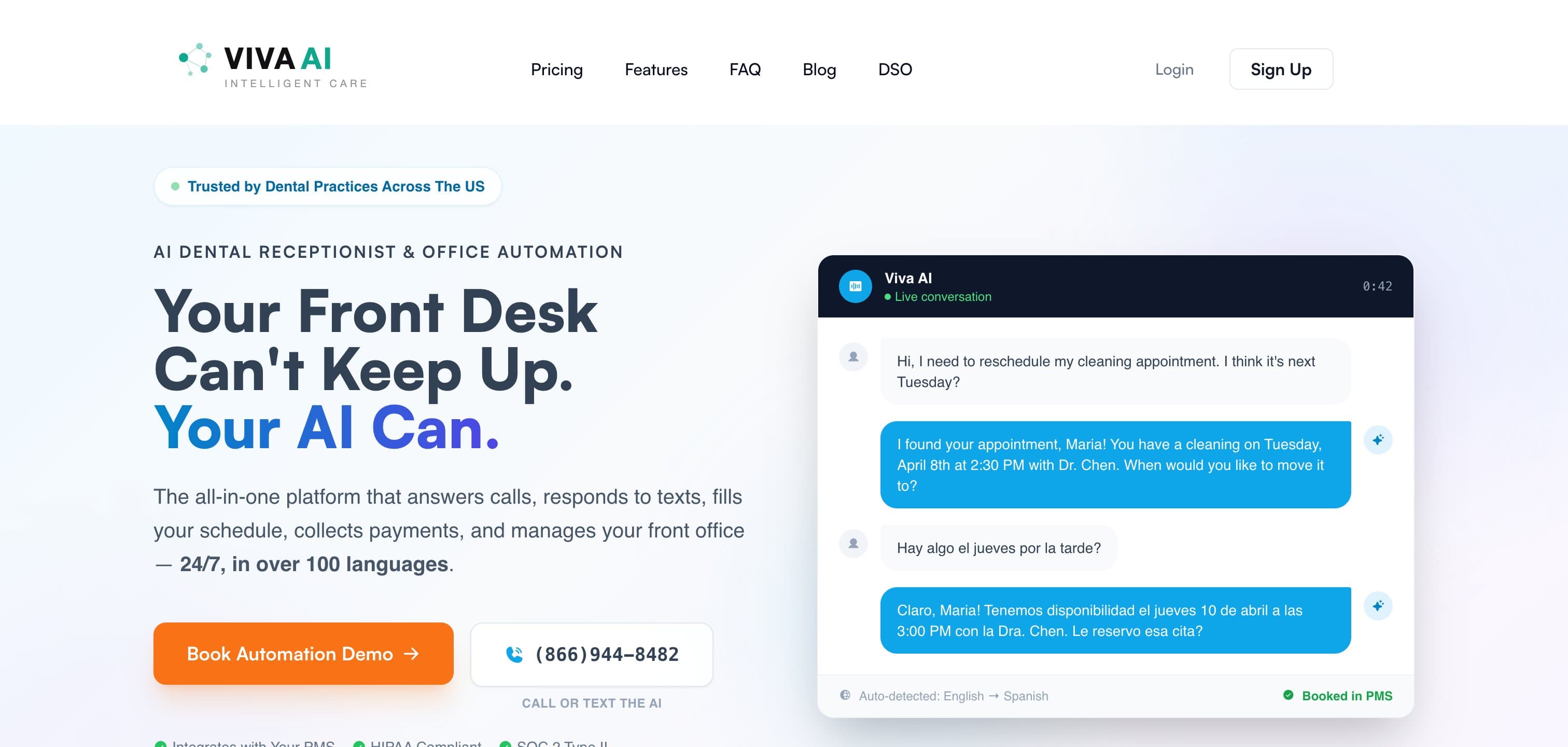
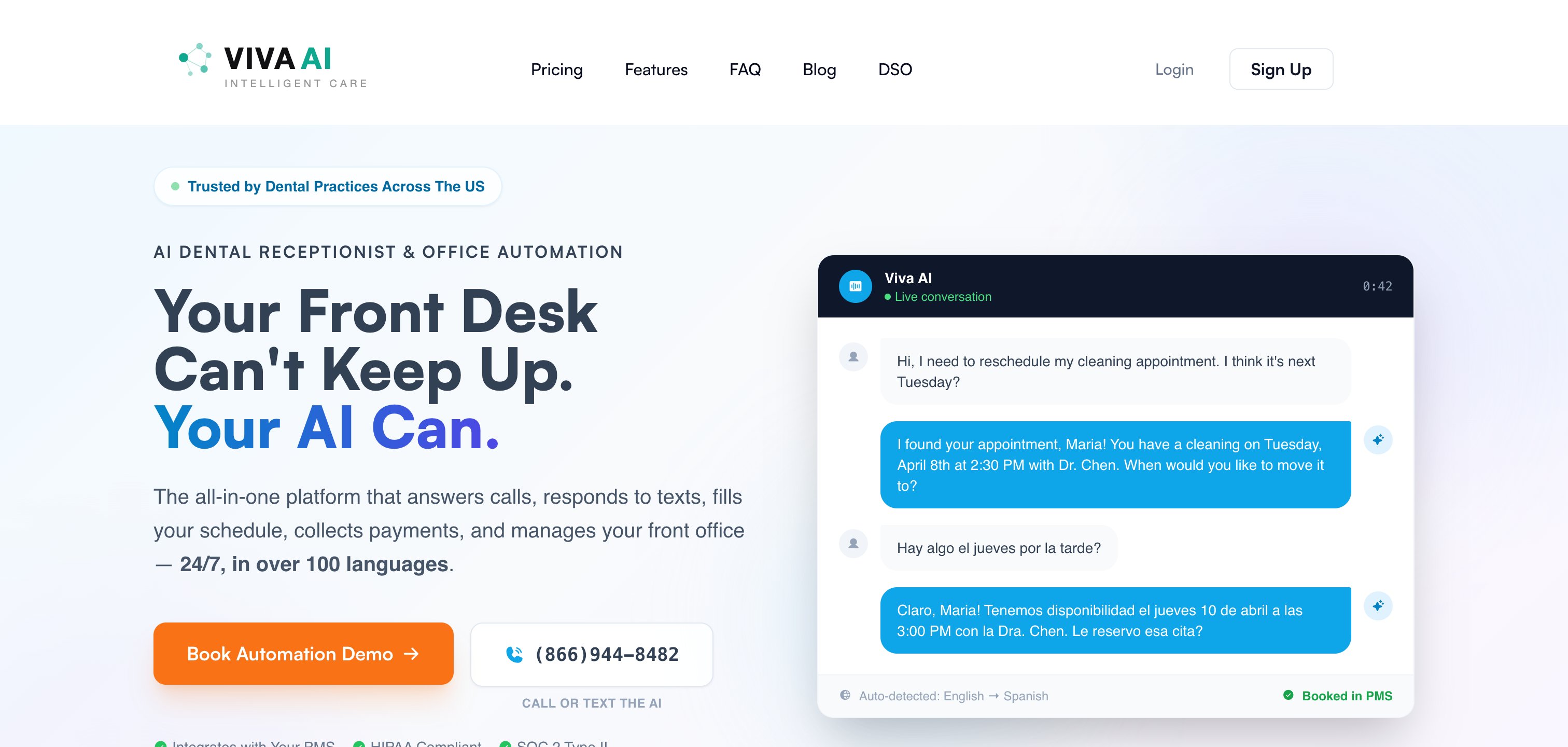
Viva AI markets itself with the tagline "Your Front Desk Can't Keep Up. Your AI Can." The product is positioned as an all-in-one dental AI platform that handles calls, text messages, payment collection, intake forms, appointment reminders, and practice analytics — 24/7, across 100+ languages.
That breadth is the core differentiator. Where Arini is dental-only AI receptionist (voice + text), Viva AI is dental-only AI platform that tries to replace three to four separate tools in the typical dental practice stack.
The three pricing tiers, explained honestly
This is where Viva AI differentiates itself from every major competitor: public pricing.
Gold — $349/month
Positioned for after-hours and overflow coverage. The AI picks up calls outside business hours and during lunch, handles basic scheduling and FAQs, and routes clinical calls to human staff. This tier is appropriate for practices that just want to stop leaking after-hours calls without replacing their in-office front desk.
My honest take: the Gold tier is priced aggressively. $349 for after-hours AI that books in real time into your PMS is genuinely cheap for what it delivers. For a practice doing $80K+/month in collections with any meaningful after-hours call volume, Gold pays for itself in the first week.
Platinum — $899/month (their "most popular")
Full automation for small offices. The AI handles all inbound calls and texts during business hours, not just overflow. Digital forms, payment collection (via Stripe), appointment reminders, patient portal, and analytics are included.
This is the tier most single-location practices should actually consider. At $899/month you get a full front-desk AI plus tooling that would cost $500-$1,200/month as separate products. The economics favor the bundle here.
Diamond — $1,199/month
Positioned for larger offices with advanced features. Additional AI analytics ("Office Optimizer"), deeper PMS write-back integration, and the premium voice/response tier.
For practices pushing $200K+/month in collections or running 2-3 locations on one Viva contract, this is probably the right tier. Below that, Platinum is usually the sweet spot.
Per-credit overages
Beyond the tier limits, Viva charges $0.08-$0.10 per additional credit, with staff tasks marked as unlimited. This is more transparent than per-minute call center pricing and aligns the incentive — the platform does not punish you for growing call volume.
Capabilities that actually ship (not marketing copy)
Evaluated across several client installations, the capabilities that are production-ready:
Voice AI with natural pauses and emotional understanding
Voice quality is on par with Arini's in our blind tests. Natural pauses, appropriate tonal shifts, clean handling of interruptions and non-linear conversations. Patients rarely detect the AI in the first 30 seconds; most complete bookings without realizing or caring.
Multilingual (100+ languages)
This is meaningfully broader than Arini. For US practices in California, Texas, Florida, or other markets with significant Spanish-primary patient populations, Viva AI's multilingual handling is genuinely useful. Our tests in Spanish showed natural fluency; tests in Portuguese and Mandarin were also acceptable. I have not tested it in less-common languages, so validate before relying.
Direct PMS write-back (not scraping)
This is important. Many cheaper "AI receptionists" integrate with dental PMS by screen-scraping the web interface, which breaks when the PMS updates. Viva AI uses direct API write-back to the major dental PMS platforms, which is more stable and supports real-time booking.
Payment collection (Stripe integration)
A differentiator. The AI can collect payment from patients during the call or text conversation — for deposits, consultation fees, overdue balances. Not every practice wants this, but for practices with significant upfront payment models (cosmetic, orthodontic), it reduces the "call patient to collect" friction meaningfully.
Outbound campaigns
Viva can initiate outbound calls for reactivation, recall, and follow-ups. This is rare among AI receptionist platforms. If you have a database of 2,000 inactive patients, Viva can run a reactivation campaign at scale that would take a human team weeks.
Digital forms and patient portal
Replaces the clipboard at check-in and provides ongoing patient access to records, billing, and communication. Competitive with dedicated intake tools like Phreesia at the Platinum+ tier.
"Office Optimizer" analytics
Diamond tier. Dashboards showing call volume patterns, booking conversion rates, missed-call analysis, staff-vs-AI handling splits. Useful for operations leadership but honestly the analytics are table-stakes in 2026 — similar depth exists on Arini and most horizontal platforms.
Claimed case study numbers (with context)
Viva AI publishes a 30-day case study with these claimed outcomes:
- $30K+ in production generated
- Zero missed calls
- 90%+ patient satisfaction
- 30 hours of staff time saved per month
These are plausible for a well-configured single-location practice at ~$150K/month in collections. Taking off the marketing gloss, the real takeaway is: when installed and tuned well, Viva AI shifts a practice from "some missed calls and slow staff" to "zero missed calls and 30 hours of reclaimed time." That is worth multiples of the monthly fee.
The customer logos on their site (Soothing Dental, Kalorama Dental Arts, Dental Arts of Irvine, Lé Dental Care) suggest mid-market single-location and small multi-location practices, which matches the Platinum tier profile.
Integrations and PMS support
Viva AI claims direct integrations with "all major dental PMS platforms." In practice, that means:
- Dentrix
- Open Dental
- Eaglesoft
- Curve Dental
- CareStack (verify version)
- Dentrix Ascend (verify version)
The PMS coverage is broader than Arini's, particularly for practices on Curve, CareStack, or Dentrix Ascend. If you are on one of these platforms, Viva is more likely to fit out of the box.
Phone system integration: Viva supports bringing your own number or porting to their system. Standard integrations with common dental phone platforms.
Where Viva AI genuinely wins vs alternatives
Compared to alternatives I have evaluated:
vs Arini: Viva publishes pricing, has broader PMS support, includes payment and forms. Arini has deeper DSO-level features and slightly cleaner voice. For single-location practices, Viva wins. For 10+ location DSOs, Arini may have the edge.
vs Synthflow: Viva is dental-specific out of the box; Synthflow is horizontal. If you want "turn it on and have dental scheduling logic already configured," Viva is faster to deploy. Synthflow is cheaper at the base tier but requires more configuration for dental-specific behavior.
vs Retell AI / Bland.ai: Viva is a productized dental vertical; Retell/Bland are developer platforms requiring you to build the dental layer yourself. For practices without internal dev resources, Viva is dramatically faster.
vs legacy answering services (Abby, AnswerConnect): not comparable. Viva books in real time; legacy services take messages. This is a generational product difference.
Where Viva AI falls short
Honest limitations:
Bundled-platform risk. Viva's pitch is "replace 3-4 tools with one." The flip side is vendor concentration. If Viva experiences downtime or pricing changes, your entire front desk stack is exposed. Some DSOs prefer best-of-breed for this reason.
Scheduling logic depth. Arini's dental scheduling intelligence (block scheduling, staggered appointments for hygienists, provider-specific preferences) is measurably deeper than Viva's in our tests. For simple scheduling models, Viva is fine. For complex multi-provider block schedules, verify carefully.
Not appropriate for non-dental. Like Arini, Viva is dental-only. If your practice mixes dental with other specialties, you need a different platform.
Configuration still matters. The "all-in-one" pitch can create the expectation of plug-and-play. In reality, Viva requires 2-4 weeks of configuration and tuning just like any AI platform. Practices that skip this phase underperform.
North America-centric. Like Arini, Viva's primary market is US/Canada dental. For LATAM, European, or Asian dental markets, local alternatives may fit better.
Who Viva AI is genuinely right for
Strong fit:
- Single-location US dental practices doing $80K-$400K/month in collections
- Small multi-location groups (2-4 practices) on supported PMS
- Practices that want ONE vendor instead of four
- Practices with significant Spanish-speaking patient bases
- Practices that collect meaningful upfront payments (cosmetic, ortho, implants)
- Practices that want published pricing and simple procurement
Weak fit:
- Large DSOs (10+ locations) where best-of-breed is preferred
- Practices on unsupported PMS platforms
- Multi-specialty practices needing AI across dental + medical
- LATAM practices where WhatsApp Business API is the primary channel
- Practices unwilling to commit to the 2-4 week tuning phase
The installation reality — what actually happens
Based on implementations I have watched:
Week 1: Initial configuration. Call flows designed, FAQs documented, escalation paths defined, PMS connection tested. Viva's team drives most of this, with practice office manager involvement on practice-specific details.
Week 2: Shadow mode. The AI handles calls but a human reviews each one before it goes live. Adjustments are made to prompts, voice, and logic. Typical adjustments: pricing responses, specialty-specific questions, insurance handling.
Week 3-4: Live mode with daily transcript review. The office manager spends ~30 minutes daily reviewing calls and flagging issues. Edge cases get tuned. By end of week 4, most practices hit 85-92% self-serve resolution.
Month 2-3: Performance stabilizes. Typical benchmarks at this point: 95%+ answer rate, 40-60% of calls resulting in booked appointments (depending on call mix), 70%+ patient satisfaction.
Practices that skip week 2-4 tuning see weaker results and often blame the platform. The platform does not fail; the configuration does.
The honest comparison to the alternatives
In our shortlisting work for dental clients:
- Viva AI wins when the practice wants ONE vendor, published pricing, and bundled features across calls + forms + payments.
- Arini wins when the practice is a multi-location DSO needing deep scheduling intelligence and has budget flexibility.
- Synthflow wins when the practice wants lower cost and has internal resources to configure dental logic.
- Hillflare medical AI wins for practices outside the US dental niche, especially LATAM WhatsApp-primary markets.
The three-way dental comparison is covered in our Arini vs Viva AI vs Synthflow piece.
The practical buying question
Before signing with Viva (or any competitor), audit your actual call data for two weeks. Count missed calls, tag new-patient inquiries, calculate current booking conversion. Walk into the Viva demo with specific numbers.
Three demo questions that separate committed vendors from sales theater:
- "Can you show me a live call transcript from a customer of similar size and specialty mix?"
- "What is the real 90-day retention rate on the Platinum tier?" High retention means the product works; low retention means customers churn when implementation disappoints.
- "What does support look like in month two when we find a configuration edge case?" The answer should describe a named support model, not generic platitudes.
Final verdict
For a single-location or small multi-location US dental practice in 2026, Viva AI is the most compelling bundled option I have reviewed. The $899/month Platinum tier delivers genuine ROI for most practices doing $100K+/month in collections.
The weaknesses — bundled-platform risk, dental-only scope, configuration discipline required — are real but manageable for the right buyer. The strengths — published pricing, broad PMS support, payment collection, multilingual — are differentiated.
If you are dental, US-based, single-to-small-multi, Viva goes on the shortlist. If you are not, read the Arini review or the Synthflow review to find the right fit.
Hillflare does not sell Viva AI directly. When a client fits the Viva profile, we help them evaluate, configure, and integrate with the rest of their stack. When the profile doesn't fit, we build on alternative platforms. Our free growth diagnosis includes a vendor-fit assessment if you want an independent read before committing.
— Hector Arriola, Founder & CEO, Hillflare
Did this article help?
Talk to a healthcare marketing expert
Book a free call and see how Hillflare can help your practice grow.
Book a free consultation →